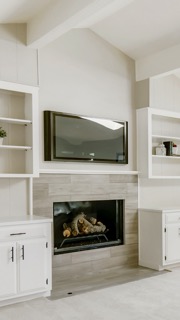
The fireplace in these photos was one of my favorite before-and-after transformations. It was years ago, but the example is still so pertinent. And who doesn’t love a “before” picture with a cat featured?
The contractors removed all the dated stone, sheetrocked the wall above the fireplace, and created a new surround with a simple, tasteful tile. And VOILA! A completely different look.
Paint is always one of my favorite and least expensive updating tools, so painting out the adjacent cabinets and overhead beams was a natural next step. Suddenly, the whole room felt lighter and more current.
We also removed the older cast-iron gas fireplace insert and replaced it with gas logs. If a fireplace already has a gas line (and many wood-burning fireplaces were installed with gas starters), the conversion to gas logs can be relatively simple and inexpensive. Of course, the existing fireplace and gas setup should always be evaluated by a qualified professional before making the switch.
I’m a big fan of a beautiful wood-burning fire. But when it comes to everyday fireplace use, I’m also a big fan of practical. Gas logs have some pretty compelling advantages:
1. No hauling messy logs into the house.
No bark, dirt, bugs or bits of wood scattered across the floor.
2. No wondering what might be living in the woodpile.
Including, in my experience, the occasional black widow. Apparently, they think firewood is prime real estate.
3. No elaborate “is-the-fire-really-out?” routine.
Sometimes you just want 20 minutes in front of the fireplace—perhaps in the morning before you rush out to start the day. With gas logs, you turn it on, enjoy the fire, and when you’re done, you turn it off. No Boy Scout-level fire-extinguishing procedure required.
So, yes, I’ve converted all of my wood-burning fireplaces to gas logs. But I haven’t given up on a good wood fire—I just moved it outside. The backyard fire pit is where I still get my wood-burning-fire fix.